Designing for the Public: What Civic Architecture Gets Wrong (And How to Fix It)
Why So Many Public Buildings Fail the People They're Meant to Serve
Designing for the Public: What Civic Architecture Gets Wrong is a question more Americans are asking — and the answers are uncomfortable.
Here is a quick summary of the core problems:
- Aesthetic disconnect — Brutalist and utilitarian styles built in the mid-to-late 20th century consistently rank as the least liked by the public, with courthouses making up more than half of the 30 ugliest public buildings in national surveys
- Neurological mismatch — Biometric research shows blank, repetitive facades actively disengage the human brain, while symmetry and human-scale detail promote comfort and connection
- Exclusion by design — Features like low bridges, poor transit placement, and hostile pedestrian environments have historically blocked entire communities from accessing public spaces
- Policy gridlock — Political battles over mandating architectural styles have stalled meaningful reform, leaving procurement processes that favor low bids over good design
When over 3,000 people were surveyed about the country's ugliest public buildings, the results pointed to a clear pattern: buildings designed to serve everyone often end up feeling like they were designed for no one. Flint's City Center ranked first on that list. More than half of the top 30 were courthouses or government centers — many built in the same era, with the same indifferent aesthetic logic.
A national Harris Poll found that Americans prefer traditional civic architecture over modernist styles by an average of 72% to 28%. That preference held across party lines. This is not a niche opinion. It is a signal that civic design, at scale, has drifted away from the people it is supposed to serve.
The consequences are real. Buildings shape how people feel about their government, their community, and their place in public life. When a courthouse feels hostile or a city hall feels irrelevant, civic trust erodes quietly — one blank facade at a time.
1. The Aesthetic Disconnect: Why Modern Civic Buildings Feel Uninspiring
When we walk past a historic courthouse with its towering columns and symmetrical windows, we often feel a sense of stability and permanence. Conversely, many of the civic buildings constructed in the mid-to-late 20th century evoke a very different reaction. According to national surveys, the public frequently identifies these structures as "ugly" or "uninspiring."
The primary culprit is often cited as Brutalism or extreme utilitarianism. These styles, which favored raw concrete, massive scales, and repetitive, windowless facades, were intended to represent honesty and strength. Instead, they often communicate coldness and bureaucracy. In a survey of over 3,000 people identifying the nation's least attractive public buildings, more than half of the top 30 were courthouses or judicial centers.
This isn't just about "old" versus "new." It's about a fundamental disconnect between architectural trends and public preference. A recent national poll showed that Americans overwhelmingly prefer traditional architecture over modernist styles by a margin of nearly three to one.
2. Designing for the Public: What Civic Architecture Gets Wrong
At Green Couch Design, we believe that what is civic infrastructure goes beyond just roads and pipes; it includes the buildings where our community gathers. When these buildings fail, it’s usually because they’ve prioritized a "signature look" or a "lowest-bid" budget over the actual human experience.
One of the most significant errors in civic design is the loss of human scale. Many modern city halls and courthouses are designed as "citadels"—massive blocks surrounded by barren concrete plazas. These designs lack identifiable entrances and fail to relate to the street level, making them feel like "shiny alien objects" rather than public assets.
Successful civic architecture, like the Newport News Courthouse, shows that even modern buildings can succeed when they incorporate clear entrances, organized curves, and a scale that doesn't overwhelm the pedestrian. When we approach a project, we ask: Does this building invite the community in, or does it push them away?
Designing for the Public: What Civic Architecture Gets Wrong in the Eyes of Science
The reason we react so strongly to certain styles isn't just a matter of "taste"—it's biological. Neuroscience and biometric research, including eye-tracking studies, show that our brains are hardwired to respond to specific patterns.
Humans naturally seek out bilateral symmetry and organized complexity. When we look at a traditional building with windows that resemble a face (two eyes, one mouth), our brains fixate on it easily, creating a sense of comfort. Conversely, the blank facades and repetitive lines common in Brutalist architecture offer no "subliminal focal points." Our eyes find nowhere to rest, which can trigger an unconscious stress response or a feeling of anomie.
Scientific research on courthouse architecture suggests that biophilic design—incorporating elements of nature, natural light, and organic shapes—can significantly reduce stress in high-stakes environments like courts. When civic architecture ignores these biological needs, it creates spaces that are cognitively draining rather than uplifting.
Designing for the Public: What Civic Architecture Gets Wrong Regarding Social Equity
Architecture has power, and historically, that power has been used to exclude. We see this in the placement of highways that cut through minority neighborhoods or in the absence of sidewalks in certain districts. These aren't just technical oversights; they are examples of architectural exclusion.
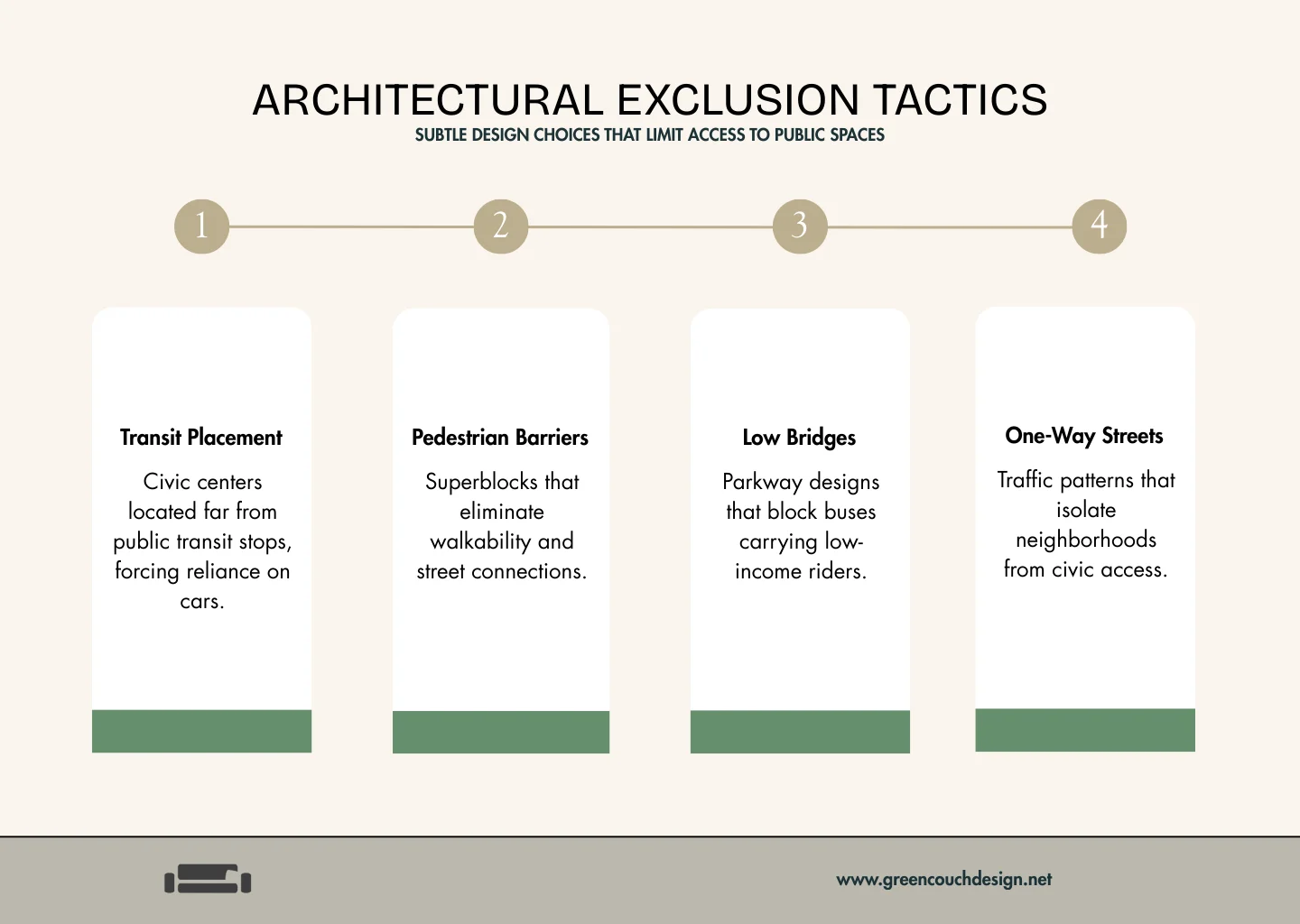
Historical figures like Robert Moses famously designed low bridges on parkways to prevent buses—often the primary mode of transport for lower-income people and people of color—from reaching public beaches. While these overt tools are less common today, subtler forms of exclusion persist:
- Transit Placement: Locating civic centers far from public transit stops.
- Pedestrian Barriers: Creating "superblocks" that are impossible to navigate without a car.
- One-Way Streets: Using traffic logic to isolate neighborhoods and prevent "cut-through" access.
We believe that civic infrastructure examples should always point toward connectivity. If a public building isn't accessible to the person taking the bus or the mother pushing a stroller, it isn't truly "public."
3. The Policy Tug-of-War: Mandating Style vs. Encouraging Innovation
The debate over what public buildings should look like has reached the highest levels of government. We’ve seen a "duel" between legislative efforts like the "Beautifying Federal Civic Architecture Act" (which leans toward classical styles) and the "Democracy in Design Act" (which emphasizes regionalism and avoiding an official style).
This debate over federal building styles highlights a core tension: should we mandate beauty, or does that lead to "Albert Speer-style despotism"?
The GSA’s 1962 Guiding Principles originally stated that an official style must be avoided and that buildings should reflect their own time. However, the problem arises when "reflecting our time" results in cheap, utilitarian boxes that the public finds repulsive. We don't believe the answer is a rigid mandate for Greek columns, but we do believe in reclaiming the "radical middle"—design that is contemporary but rooted in the universal principles of symmetry, scale, and material quality that have resonated with humans for centuries.
4. Reclaiming the Commons: Practical Solutions for Purposeful Design
Fixing civic architecture requires moving away from "procuring potatoes" (treating design like a commodity) and toward a process that values legacy and community vision.
One of our proudest examples of purposeful renovation is the Pawnee Courthouse Renovation. In projects like this, our goal is to preserve the dignity of the original structure while ensuring it meets modern functional needs. We focus on making the space feel like a "commons" again—a place where the public feels they belong.
Similarly, our work on the Catalyst Youth Facility shows how architecture can serve a specific social purpose. By creating an environment that feels safe, intentional, and high-quality, we send a message to the users that they are valued.
| Feature | Exclusionary Design | Inclusive Design |
|---|---|---|
| Scale | Monumental/Overwhelming | Human-scale/Approachable |
| Entrances | Hidden or single-point | Clear, multiple, and transparent |
| Plazas | Empty concrete "moats" | Programmed green spaces |
| Materials | Raw concrete/Reflective glass | Natural stone, wood, and brick |
| Transit | Car-dependent | Multi-modal/Pedestrian-friendly |
To fix civic architecture, we recommend:
- Community Visioning: Engaging the public early in the design process through charrettes.
- Traffic Calming: Redesigning the streets around civic buildings to favor people over cars.
- Event Programming: Ensuring that public plazas are managed and programmed with markets or events so they don't sit empty.
- Fixed Design Fees: Moving away from "lowest bid" procurement that forces firms to cut corners on design quality.
Frequently Asked Questions about Civic Architecture
Why do many people find modern courthouses and city halls "ugly"?
Many of these buildings were designed during the mid-20th century when Brutalism and utilitarianism were dominant. These styles often lack the symmetry, detail, and natural materials that human brains are biologically wired to find comforting. Additionally, a lack of maintenance can make these heavy concrete structures look drab and neglected over time.
How does architectural exclusion affect community access?
Architectural exclusion uses physical barriers—like a lack of sidewalks, low bridges, or the placement of buildings far from public transit—to make it difficult for certain groups to access public spaces. It functions as a silent form of regulation, dictating who can easily enter a space without ever writing a law.
Can traditional architectural styles coexist with modern functionality?
Absolutely. At Green Couch Design, we specialize in blending "old-soul" aesthetics with modern-day performance. You can have a building that looks timeless and symmetrical on the outside while featuring state-of-the-art technology, energy efficiency, and accessibility on the inside.
Conclusion
Designing for the Public: What Civic Architecture Gets Wrong isn't an unsolvable problem. It's a call to return to intentional, values-driven design. Civic buildings are the physical manifestation of our shared values; they should be built to last, both technically and emotionally.
We believe that every public project is an opportunity to build a legacy. Whether we are working on a commercial space in Oklahoma City or a historic renovation, our process remains the same: we listen, we collaborate, and we design for the people who will actually use the space.
If you’re interested in learning more about how we approach these challenges, explore our work in civic and public architecture. Let’s build something that serves the public for generations to come.