When the Land Has Opinions: What Really Changes on a Wooded Oklahoma Lot

Building on a wooded lot in Oklahoma changes nearly every phase of your project — from the first site visit to the final foundation pour. Here's what's different:
| Challenge | Why It Matters on a Wooded Lot |
|---|---|
| Site clearing | Vegetation density, tree size, and terrain drive cost and method selection |
| Soil and foundations | Oklahoma's expansive clay shifts more dramatically under tree root zones |
| Drainage | Tree removal disrupts natural absorption; grading becomes critical |
| Utilities | Rural wooded acreage often requires wells, septic, and new electric runs |
| Legal risks | Boundary trees and neighbor disputes carry serious financial consequences |
| Permitting | Zoning setbacks, easements, and county rules vary widely by location |
| Budget | Pre-construction costs alone can run $5,000–$15,000 before a single wall goes up |
Oklahoma's wooded land is genuinely beautiful — mature oak canopies, creek-bottom timber, rolling terrain. But pretty land and buildable land are not always the same thing. The trees, the clay, the topography — they all have something to say about how, where, and whether you can build. Ignoring them early is how projects stall, budgets blow up, and neighbors end up in court over a fence line.
This guide walks through what actually changes when your lot has trees — and how to make decisions that protect both your investment and the land itself.
At Green Couch Design, our team has worked through the full arc of site-specific design challenges — including the kind that start long before a blueprint exists — bringing the same intentional, process-driven approach to building on a wooded lot in Oklahoma that we apply to every complex project we take on. The sections ahead draw on our collective experience, along with the technical realities of Oklahoma soil, law, and land — so you can move forward with clarity, not costly surprises.
_compressed.webp?alt=media&token=9d7b7b7c-ab87-43ab-8b45-ec892f10bf56 "user-inserted")
The Feasibility Phase: Reading the Wooded Landscape
Before you fall in love with a specific clearing on your new property, you must determine if the land can physically support your build. We call this the active due diligence phase. Evaluating a wooded lot is not just about checking property boundaries; it requires analyzing how the trees, topography, and soil interact with your future home.
During the Feasibility Stage of a Project, we look at the site through a lens of both preservation and practicality. If you are looking to purchase or build, you must Evaluate a Commercial Property Before You Buy or Build (or a residential lot) with an eye for hidden constraints. On wooded land, these constraints often hide behind beautiful foliage. We look for signs of seasonal creek flooding, steep elevation drops that require complex retaining walls, and pockets of dense, protected timber that cannot easily be cleared.
Designing for the Trees: Building on a Wooded Lot in Oklahoma: What Changes When the Land Has Opinions
When we design a home for a wooded site, we do not treat the trees as obstacles to bulldozed out of existence. Instead, we treat them as design partners. The canopy provides natural shading that can drastically reduce your cooling loads during hot Oklahoma summers, which is highly beneficial if you are interested in integrating Solar Panels in Oklahoma or implementing smart Active and Passive Solar strategies.
Working with an architect early on helps you understand When Custom Residential Design Is Worth the Investment (and When It's Not). A custom-designed home can step down a sloped wooded hill, preserving mature 100-year-old oaks, whereas a standard builder plan might require clear-cutting the entire ridge. When faced with the choice of how to handle your trees, you must ask yourself: should you keep, remove, or build around them? Consulting resources on Buying Land With Trees: Keep, Remove, or Build Around? can help you decide how to balance natural beauty with structural footprint safety.
Building on a Wooded Lot in Oklahoma: What Changes When the Land Has Opinions
Once you move from planning to physical preparation, the land's "opinions" become very practical. How you clear the site directly dictates the long-term health of your soil, your home's foundation, and your overall project budget.
Traditional site clearing often defaults to brute force, but a more selective approach usually protects more of what makes a wooded lot valuable. On Oklahoma acreage, the right clearing strategy can reduce unnecessary disturbance, preserve topsoil, and help avoid expensive pre-construction problems later.
Selecting the Right Clearing Method for Your Site
There are two primary methods for preparing your building envelope: forestry mulching and traditional grubbing/dozing.
- Forestry Mulching: This method uses a specialized machine to cut, grind, and clear vegetation, leaving a rich layer of organic mulch behind. It is highly effective for preserving topsoil, preventing erosion during heavy Oklahoma spring rains, and protecting the root zones of nearby trees you wish to save.
- Traditional Grubbing and Dozing: This involves using heavy bulldozers to scrape the land clean, pulling up tree stumps, roots, and underbrush. While necessary for the immediate footprint of a slab-on-grade foundation, it leaves the surrounding soil raw, highly vulnerable to erosion, and muddy.
| Feature / Method | Forestry Mulching | Traditional Bulldozing |
|---|---|---|
| Typical Cost | $400 - $800/acre (moderate); $1,000 - $2,500/acre (dense) | Variable; often higher when haul-off/burning is required |
| Topsoil Impact | Preserves topsoil; adds protective organic layer | Scrapes away topsoil; increases erosion risk |
| Stump Removal | Cuts trees flush to ground; leaves root systems intact | Extracts stumps and roots completely (grubbing) |
| Erosion Control | Excellent; mulch layer holds moisture and soil | Poor; requires immediate silt fencing and seeding |
| Best Use Case | Clearing underbrush, driveways, and fire breaks | Direct home footprint and septic lateral line fields |
Soil, Topography, and Foundation Engineering
Oklahoma's red dirt is famous, but beneath that vibrant color lies a challenging material: highly expansive clay soil. This clay acts like a sponge, swelling significantly when wet and shrinking during dry summer droughts.
When you build on a wooded lot, the soil dynamics are even more complex. Trees draw massive amounts of moisture out of the ground. If you clear a group of mature trees to build a house, the clay soil that was once kept dry by those thirsty root systems will suddenly saturate and expand, putting immense upward pressure on your foundation.
This is why a professional geotechnical soil analysis is often a non-negotiable, particularly for commercial ground-ups. To prevent foundation cracking and structural failure, custom builds in regions like Edmond, Norman, and Oklahoma City often require heavily engineered post-tension slab foundations or deep pier systems. You can read more about these structural requirements in this Building a House on Your Land: Oklahoma Guide by ACET Homes.
Site Preparation Realities: Building on a Wooded Lot in Oklahoma
Proper grading is your home's primary defense against water damage. In Oklahoma, clay-heavy soils require at least a 2% slope grading away from the foundation to prevent water from pooling near your concrete.
If your wooded lot features sloped topography, managing runoff is critical. When trees are removed, the natural "sponges" of the forest are gone, causing stormwater to flow faster and pool in new areas. To combat this, we often design custom drainage solutions, such as dry creek beds, French drains, or even elevated pier foundations.
For example, on highly sloped, flood-prone, or densely wooded lots, elevating the home on concrete piers—much like a high-end treehouse—allows natural water runoff to pass unimpeded beneath the structure without threatening the home's Building Envelope Construction or disrupting the natural forest floor.
Navigating Utilities and Infrastructure in Dense Timber
One of the most common surprises for landowners building on wooded acreage is the sheer cost of bringing utilities to the home. Beautiful, secluded clearings are often hundreds of feet away from the nearest county road or utility pole.
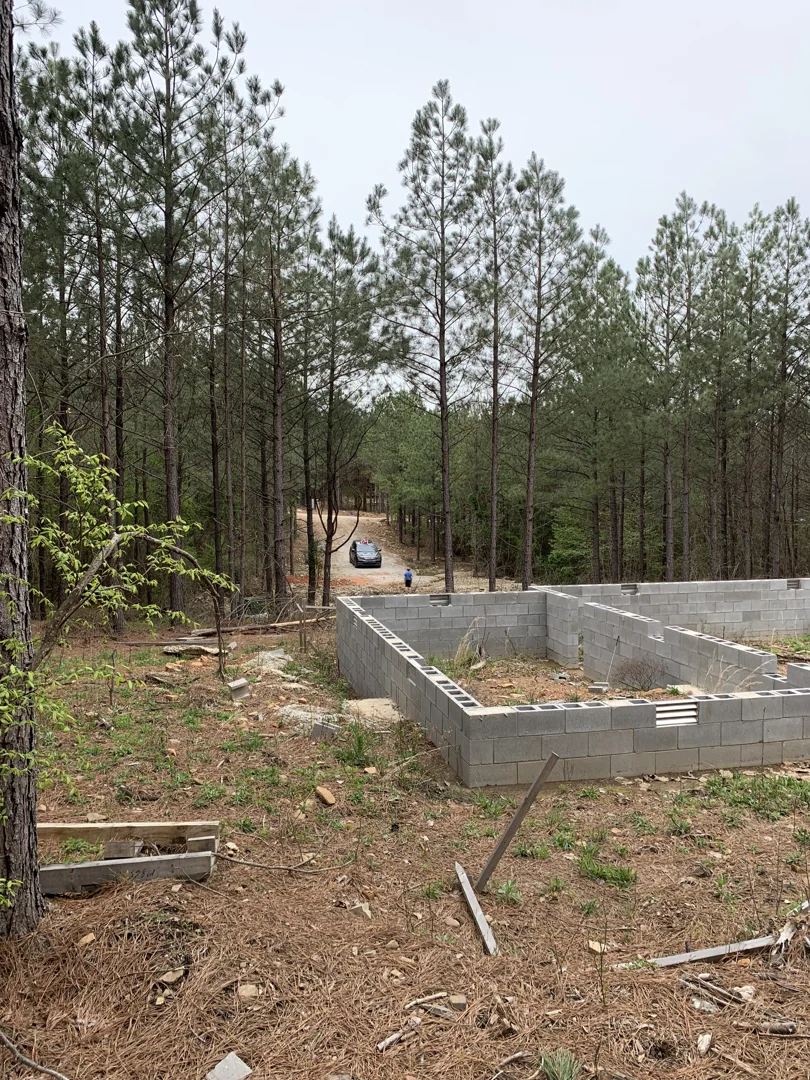
Before committing to a site layout, you must answer basic infrastructure questions. If you are wondering about general buildability, check out Can You Build On Land In Oklahoma - Oklahoma Buy Land to understand how access, water, and septic availability dictate your build.
- Water: Is municipal or rural water nearby, or will you need to drill a water well?
- Wastewater: Wooded areas rarely have municipal sewer access. You will likely need a private septic system. Because septic lateral lines require clear, undisturbed ground to function, you will have to clear additional timber specifically for your septic field.
- Power: Local electric cooperatives will run lines to your home, but trenching underground power lines through a dense forest means cutting through tree roots, which can kill mature trees. Overhead lines, on the other hand, require clearing a permanent, wide easement through your canopy.
Access Roads and Driveway Construction
To get heavy construction equipment, concrete trucks, and emergency vehicles to your site, you must build a reliable access road early in the process.
A standard dirt path will quickly turn into an impassable mud pit during Oklahoma's spring rains. A proper rural driveway should be a minimum of 12 feet wide (preferably 16 to 20 feet for construction traffic) and built with a compacted gravel base. It should feature a crowned center to shed water to both sides and include properly sized culverts (usually 18 to 24 inches) where the driveway crosses existing drainage ditches.
Legal Boundaries, Tree Ownership, and Zoning Regulations
Building in unincorporated Oklahoma County offers immense freedom, but municipal limits like Oklahoma City or Deer Creek bring strict zoning regulations.
If your wooded lot falls within Oklahoma City limits, you must comply with local municipal codes. Specifically, ARTICLE XI. | Code of Ordinances | Oklahoma City, OK outlines strict landscaping, tree preservation, and site clearing standards. These ordinances often dictate how many mature trees you must preserve, setback requirements from property lines, and how much green space must remain untouched.
Avoiding Neighbor Disputes and Wrongful Tree Removal
Never clear a single tree until you have a licensed surveyor physically mark your exact property boundaries. Under Oklahoma law, trees growing directly on a boundary line are jointly owned by both adjoining landowners.
Removing or damaging trees across your property line—even by accident during site clearing—carries massive financial and legal risks. Under Oklahoma's timber-damage statutes, if you wrongfully cut down or damage a neighbor's trees, the court can award damages ranging from three to ten times the actual value of the lost timber.
This is not just the cost of a sapling at a local nursery; the courts calculate the value of mature, decades-old trees based on property value drops, debris removal, and intrinsic landscape value. A cautionary tale of how quickly a friendly relationship can turn into a legal nightmare over unauthorized tree removal is detailed in this report on an Oklahoma Property Damage Dispute - Operation Sports.
Budgeting and Timeline Realities for Wooded Site Prep
When preparing your overall budget, it is easy to focus entirely on the cost of lumber, concrete, and finishes. However, preparing a wooded lot requires a healthy pre-construction contingency budget.
A realistic budget for a basic rural homesite covering clearing, grading, driveway installation, and a culvert often runs $5,000 to $15,000 before actual home construction begins. If you are unsure how to structure your team or budget early on, understanding the roles of a Residential Architect vs Builder: Who You Should Hire First can save you thousands in redundant site planning.
Estimating Your Pre-Construction Expenses
To keep your expectations grounded, keep these standard industry timelines and costs in mind:
- Clearing Speed: Professional clearing crews can clear anywhere from 1 to 15 acres per day depending on the density of the brush and the clearing method used. Light brush goes quickly, while dense hardwood forests with large trees can take up to a week per acre.
- Forestry Mulching Costs: Typically runs approximately $700 per acre with a 3-acre minimum for basic underbrush clearing. Dense, heavy timber areas can easily reach $1,000 to $2,500 per acre.
- DIY vs. Professional Timelines: While renting a skid-steer to clear your own land is tempting, DIY land clearing projects typically take 3 to 5 times longer than professional estimates, often resulting in higher equipment rental fees and unexpected site damage.
Frequently Asked Questions about Building on Wooded Oklahoma Lots
Do I need a permit to clear trees on my rural Oklahoma property?
In most unincorporated rural areas of Oklahoma, no permit is required for basic vegetation clearing or forestry mulching. However, if your property lies within municipal limits (such as Oklahoma City or Deer Creek), you are subject to local zoning ordinances and may need a site-clearing or land-disturbance permit before removing significant timber.
How much does it cost to prepare a wooded homesite in Oklahoma?
While basic site prep budgets run between $5,000 and $15,000, heavily wooded lots with steep slopes, long utility runs, or complex septic needs can easily push site preparation costs above $25,000.
How do trees affect my home's foundation in Oklahoma clay soil?
Tree root systems act as powerful water pumps. During dry seasons, they draw massive amounts of moisture from the clay beneath your home, causing the soil to shrink unevenly. This localized shrinkage can cause foundation settling, cracking, and structural failure. Maintaining a safe distance between mature trees and your foundation is vital.
Designing for the Long Haul
Building on a wooded lot in Oklahoma is an incredibly rewarding journey, but it requires a design team that respects the natural boundaries of the land. At Green Couch Design, we specialize in purposeful, resilient, and site-specific OKC Residential Architecture. We don't fight the land; we design homes that feel like they grew naturally from the forest floor.
If you're ready to build a lasting legacy on your Oklahoma property, let's start a conversation. We will help you navigate the zoning, the soil, and the trees—ensuring your home stands beautifully for generations to come.