The First Six Conversations to Have Before You Design Your Custom Home
Why the First Conversations You Have Shape Every Decision That Follows
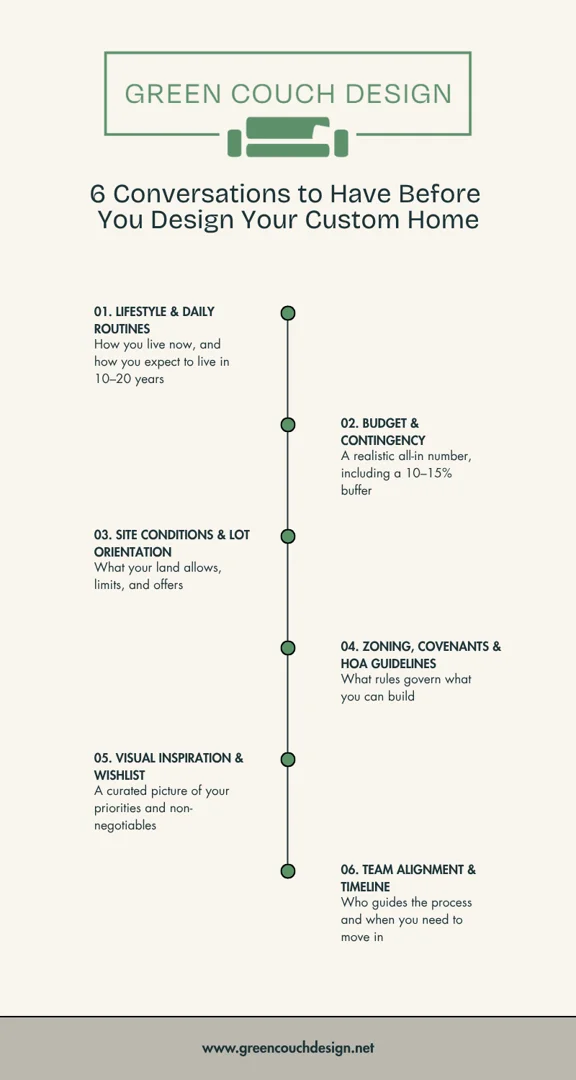
The first six conversations to have before you design your custom home are the ones that determine whether your project runs smoothly — or becomes a costly, stressful rebuild of decisions made too late.
Here they are at a glance:
- Lifestyle and daily routines — How you live now, and how you expect to live in 10–20 years
- Budget and contingency — A realistic all-in number, including a 10–15% buffer
- Site conditions and lot orientation — What your land allows, limits, and offers
- Zoning, covenants, and HOA guidelines — What rules govern what you can build
- Visual inspiration and wishlist — A curated picture of your priorities and non-negotiables
- Team alignment and timeline — Who guides the process and when you need to move in
Most homeowners arrive at their first design meeting excited — and underprepared. They have Pinterest boards and a rough square footage in mind, but they haven't yet worked through the foundational questions that shape every floor plan decision, every budget line, and every permit application that follows. The result? Change orders, redesigns, and the kind of decision fatigue that turns a dream project into an exhausting one.
The good news: a little structured thinking up front changes everything.
At Green Couch Design, we've learned that custom home projects go more smoothly when a few key conversations happen early. Talking through these first six topics before design begins can save time, reduce stress, and help protect your investment.
1. Defining Lifestyle and Daily Routines
The most beautiful home in Oklahoma is a failure if it does not fit the way you move through your day. Too often, homeowners focus on the look of a home rather than the life lived inside it.
We encourage you to analyze your spatial flow. Do you enter through the garage with three kids, two dogs, and muddy sports gear? If so, a tiny, dark mudroom will become a daily source of frustration. Do you work from home? A desk tucked into a noisy kitchen corner rarely supports deep focus. You need to identify your true room priorities and design from the inside out.
Additionally, we must talk about right-sizing. There is a common temptation to build massive homes to solve storage or layout issues, but we frequently caution clients about The Downside of Building Super-Sized Homes. Larger homes mean higher utility bills, more maintenance, and often, vast spaces that feel cold and underutilized. Instead, focus on purposeful, high-functioning spatial design that maximizes every square foot.
To design for daily flow, your conversations must account for family dynamics and future-proofing. Ask yourselves:
- Who lives in this home now, and who will live here in ten years?
- Do we want to age in place? (If so, wider hallways, curbless showers, and a main-level primary suite are essential).
- Do we host large family gatherings in Midwest City, or do we prefer quiet evenings?
- How does noise travel? Where should the kids' bedrooms sit in relation to the main living area?
Clarifying these lifestyle needs and priorities before starting the design process is directly tied to fewer change orders and a smoother construction process. Working through these details early—long before meeting with professionals—gives your design team a clear target.
2. Establishing a Realistic Budget and Contingency
Let's address the elephant in the room: money. Statistically, 70% of custom home projects experience cost overruns when budgets are not established before design begins.
A common pitfall is the "chicken-and-egg" budget problem. Homeowners are hesitant to name a budget because they don't know what things cost, and builders are hesitant to price a home without completed architectural plans. To break this cycle, you must establish an honest, comfortable budget range early.
This range must include a 10–15% contingency budget. This is not "extra" money for luxury upgrades; it is your breathing room. It covers unexpected site conditions, utility hookup adjustments, or the natural price fluctuations of materials.
When financing, we highly recommend working with local Oklahoma banks rather than national institutions. Local lenders understand the OKC metro market, offer smoother construction draw processes, and maintain personal relationships that keep projects moving forward. Understanding this financial landscape helps you evaluate When Custom Residential Design Is Worth the Investment (and When It's Not).
To help visualize how custom home budgets differ from standard production builds, consider this baseline comparison:
| Cost Category | Standard Builder Home | Custom Architectural & Interior Design |
|---|---|---|
| Site Prep & Foundation | Standard flat slab | Engineered for topography & soil |
| Architectural Detailing | Basic trim packages | Custom millwork, integrated storage |
| Window & Light Design | Standard builder-grade | High-performance, optimized placement |
| Contingency Buffer | Rarely planned (leads to stress) | 10–15% integrated from day one |
3. Analyzing Site Conditions and Lot Orientation
You cannot design a custom home in a vacuum. The land must dictate the floor plan. If you buy a stock house plan online and try to force it onto a sloped lot in Oklahoma City, you will spend tens of thousands of dollars in unnecessary dirt work and retaining walls.
The orientation of your lot determines how natural light enters your home. Proper sun orientation can make a home feel incredibly bright and spacious without adding a single square foot. It also directly impacts your energy bills; strategic roof overhangs and window placements can block the harsh Oklahoma summer sun while welcoming the soft winter light.
Additionally, we must evaluate:
- Topography and slope: How does water drain across the property?
- Soil conditions: Central Oklahoma is famous for shifting red clay, which requires specific foundation engineering.
- Views and privacy: Where should the primary bedroom look out to maintain privacy from neighbors?
We call this process grounding your home to the earth, a concept we explore deeply in Place Making: Ground Your Home.

4. Navigating Zoning, Covenants, and HOA Guidelines
Before you fall in love with a modern, flat-roofed design, you must understand the legal boundaries of your property. Neighborhood covenants, deed restrictions, and Homeowners Association (HOA) guidelines play a massive role in shaping what you can build.
Many neighborhoods in Edmond, OKC, and Midwest City have strict regulations regarding:
- Minimum and maximum square footage
- Exterior material percentages (e.g., requiring 80% brick or stone)
- Setbacks and easements (how close the house can sit to the property lines)
- Roof pitches, garage placement, and fence heights
Ignoring these rules until the design phase is completed can result in devastating setbacks. You do not want to pay for a full set of architectural plans only to find out the HOA rejects your exterior design. This is why having precise, legally compliant plans is vital before any physical work begins—a topic we highlight in Why You Need Construction Documents Before You Start a Renovation. If your current lot or home restrictions are too tight, you may even need to have the tough conversation of whether to Add On or Move On.
5. Curating Visual Inspiration and the Wishlist
When clients arrive with thousands of unorganized Pinterest pins, it actually increases design friction. Instead, we recommend a highly focused approach to visual inspiration.
Gather 10 to 20 curated images that represent the absolute core of what you want to achieve. For each image, write down 3 to 5 "style words" explaining exactly why you saved it. Do you love the natural light? The texture of the stone? The way the kitchen island connects to the dining table?
This keeps the focus on design outcomes rather than rigid scripts. Your architect's job is to take your feelings and functional needs and translate them into a unique space, not to simply copy another home. Think of this as defining your "Gold" non-negotiables.

6. Aligning Your Team and Timeline
The final, and perhaps most critical, pre-design conversation is deciding who will guide you through this journey. A successful custom home requires a harmonious relationship between your architect and your builder.
Historically, homeowners hired an architect, completed the plans, and then shopped them around to builders. This often led to heartbreak when the builders priced the completed plans far above the client's budget. Today, we advocate for a collaborative, team-first approach where the builder and architect work together from the very beginning. This ensures that every creative design decision is instantly vetted against real-world material costs and local labor availability.
To understand how to structure this team, it helps to read about Residential Architect vs Builder: Who You Should Hire First.
Choosing the Right Partners
Choosing a team that guides the entire process from planning to construction leads to clearer communication, fewer surprises, and higher satisfaction.
When interviewing potential partners, establish clear communication expectations and ask about their specific project delivery methods. If you are tempted to save money by managing the build yourself, make sure you understand the immense time commitment and risks outlined in Being Your Own General Contractor.
For a deeper dive into how this collaborative process unfolds in real life, check out the Steps to Building a House - The Custom Home Building Process. You can also learn more about selecting local professionals in this Custom Home Builder Guide: Oklahoma City Experts or listen to expert discussions on the Let Jaime Talk Podcast #5 - What is the Process of ... - YouTube.
Frequently Asked Questions About Pre-Design
How long does the pre-design phase typically take in 2026?
In May 2026, the pre-design phase—from initial lifestyle conversations to site analysis and zoning checks—typically takes 4 to 8 weeks. Allowing this phase to unfold naturally, rather than rushing, ensures permitting flexibility and keeps the construction schedule on time.
Can we design a home before purchasing a lot?
We strongly advise against this. Because site-specific design relies heavily on topography, sun paths, soil conditions, and local HOA setbacks, a plan designed without a specific lot will almost always require costly, time-consuming redesigns once the land is purchased.
But, occasionally, we work with a client on a layout and charge an additional fee to come back and tweak the site design and placement of the custom home once the lot is secured.
How do we prevent budget overruns during the design phase?
The best way to prevent budget overruns is early cost alignment. By bringing a builder into the conversation during the early schematic design sketches, you can get real-time pricing feedback and perform value engineering before the final construction documents are drafted.
Conclusion
Building a custom home is a legacy-driven endeavor. It is a physical manifestation of how you value your family's daily life, comfort, and future. By intentionally sitting down to have the first six conversations to have before you design your custom home, you lay a foundation of clarity, financial safety, and design purpose.
At Green Couch Design, we believe in interior design and architecture on purpose. We design homes that ground you to your land, serve your daily routines beautifully, and stand as a testament to thoughtful, deliberate planning.
Ready to begin your journey with a team that guides you through every step of this process? Partner with an OKC Residential Architect at Green Couch Design today, and let's build something beautiful together.