An Architectural Tour of OKC's Public Art
Why OKC's Public Art Belongs on an Architectural Tour
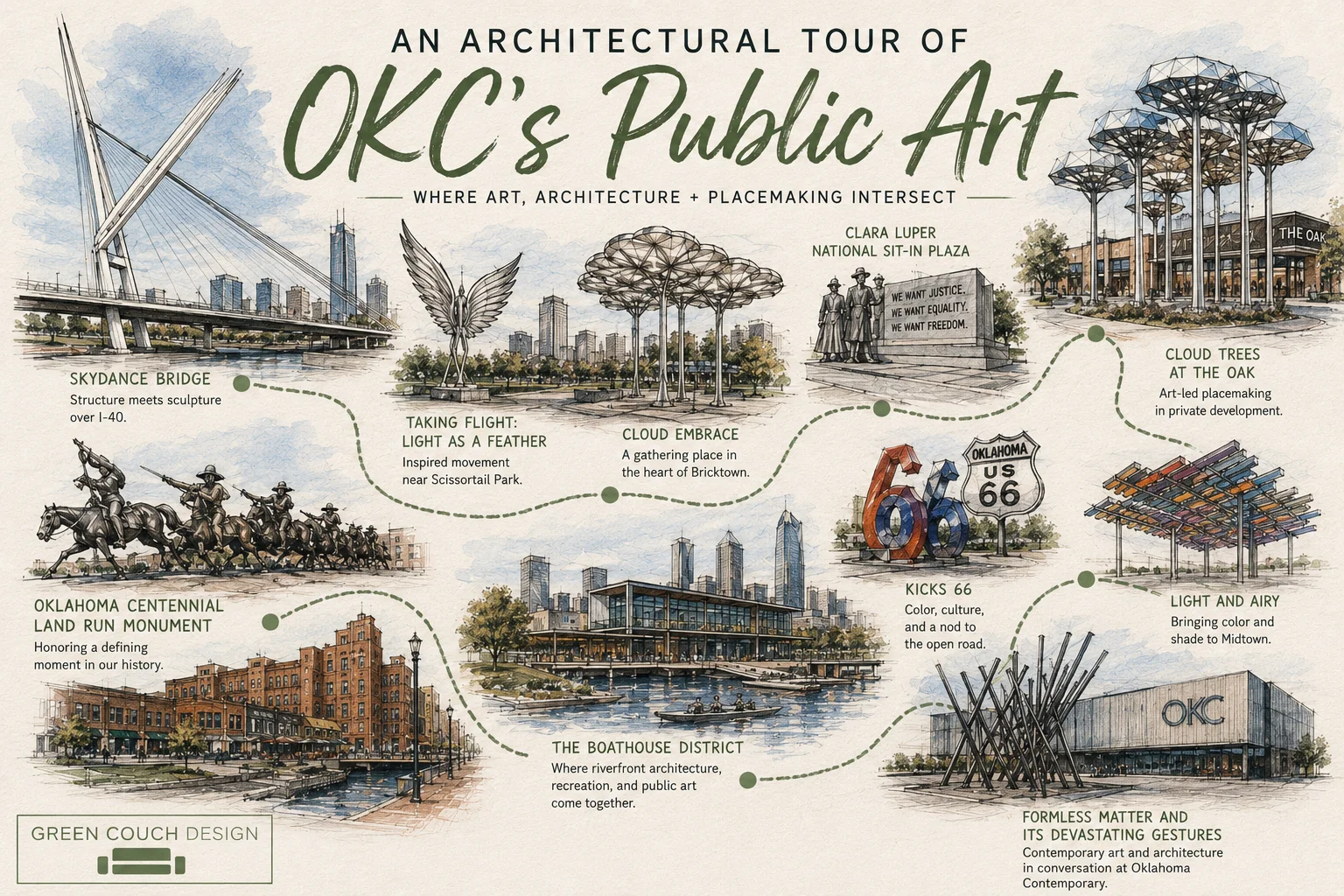
An Architectural Tour of OKC's Public Art reveals a city where civic identity, architecture, and public space work together. This is not just a sightseeing list. It is a combined tour through downtown, Bricktown, Scissortail Park, Midtown, the Boathouse District, The OAK, and Oklahoma Contemporary, with each stop showing how art can turn infrastructure into a place people remember.
Here is the route this post focuses on:
- SkyDance Bridge, where structure and sculpture meet over I-40
- Oklahoma Centennial Land Run Monument in Bricktown
- Taking Flight: Light as a Feather and Cloud Embrace near Bricktown and public spaces
- Clara Luper National Sit-In Plaza, where civic memory becomes part of the streetscape
- Cloud Trees at The OAK, a new example of art-led placemaking in private development
- Kicks 66 and Light and Airy, which add color, scale, and pedestrian interest to OKC's public realm
- The Boathouse District, where riverfront architecture, recreation, and art as buildings overlap
- Formless Matter and Its Devastating Gestures at Oklahoma Contemporary
Oklahoma City's transformation did not happen by accident. It required decades of civic investment, thoughtful district planning, and a community-wide decision that public spaces should carry meaning, not just traffic.
At Green Couch Design, we approach architecture with this same purposeful mindset. Our background in branding and functional design gives us a deep appreciation for how public art integrates with buildings, streets, parks, and commercial destinations. In the sections ahead, we will walk through the tour stops and close with what they teach us about placemaking, business identity, and civic design.
An Architectural Tour of OKC's Public Art
A good tour of Oklahoma City's public art has to be more than a list of murals and monuments. The strongest pieces help you understand how OKC has used architecture, infrastructure, parks, and district development to shape a stronger sense of place.
This route moves through several connected parts of the city: downtown, Bricktown, Scissortail Park, Midtown, The OAK, the Boathouse District, and Oklahoma Contemporary. Each area shows a different side of public art's role in the built environment.
Downtown and Scissortail Park: Infrastructure as Landmark

Start with the iconic SkyDance Bridge, one of the clearest examples of public infrastructure becoming civic art. Inspired by the scissor-tailed flycatcher, the bridge turns a pedestrian crossing over I-40 into a sculptural gateway for the city. It does not hide its structure. It celebrates it.
Near Scissortail Park, works like Taking Flight: Light as a Feather and Cloud Embrace continue that theme. They make open space feel intentional rather than leftover. The park, bridge, and surrounding public art work together as a sequence of experiences: movement, pause, view, gathering, and memory.
That sequence matters architecturally. Public spaces succeed when people can intuitively understand where to go, where to stop, and why a place feels distinct. Art helps create those cues.
Bricktown: Public Art as Shared Memory
Bricktown's public art has a different tone. Here, the city leans into history, tourism, and civic storytelling. The Oklahoma Centennial Land Run Monument is one of the most recognizable examples, using scale and movement to turn a historic narrative into a physical experience along the canal.
This is where public art becomes a form of orientation. Visitors may not know every building or street name, but they remember the monument, the canal, the brick facades, and the feeling of moving through a district with a clear identity.
The same principle applies in architecture. A memorable place does not happen because one object is beautiful in isolation. It happens when buildings, paths, landscape, signage, and public art reinforce the same story.
Midtown, The OAK, and New Development: Art-Led Placemaking
Midtown shows how public art can support a district shaped by adaptive reuse, walkability, and small-scale commercial life. Pieces like Kicks 66 and Light and Airy add color, surprise, and pedestrian interest. They give people a reason to slow down and notice the built environment instead of simply passing through it.
At The OAK, Cloud Trees shows how private development can use art as more than decoration. The mirrored forms reflect the sky, trees, and people moving around them, making the work feel tied to the site instead of placed on top of it.
That is the difference between decoration and placemaking. Decoration fills space. Placemaking gives space a role in how people gather, shop, work, and remember a destination.
Clara Luper Plaza, the Boathouse District, and Oklahoma Contemporary
The Clara Luper National Sit-In Plaza brings another essential layer to the tour: public art as civic recognition. It anchors an important civil rights story in the public realm, making history visible in the daily life of the city.
The Boathouse District offers a more active, recreational version of placemaking. Its riverfront architecture, rowing facilities, trails, lighting, and public spaces show how design can turn a formerly overlooked edge of the city into a destination.
Finally, Formless Matter and Its Devastating Gestures at Oklahoma Contemporary expands the tour into the world of contemporary art and architecture. Oklahoma Contemporary itself is a strong example of how a building can become part of the cultural experience, not just the container for it.
Together, these stops show a city using public art at multiple scales: bridge, plaza, district, park, commercial development, museum, and riverfront.
What Public Art Teaches Us About Architecture, Business, and Civic Identity
At Green Couch Design, we believe the best buildings do more than solve a space problem. They help people understand who a business is, how a community sees itself, and why a place is worth returning to.
Public art makes that lesson visible across Oklahoma City.
Placemaking Is Not Just for Parks and Monuments
To design better public spaces, we must first ask: What is Civic Infrastructure? Simply put, it is the network of public spaces, buildings, and systems that allow a community to function and connect.
When you look at Civic Infrastructure Examples around Oklahoma City — from Scissortail Park to public libraries, recreation centers, and district streetscapes — you see how functional design can foster civic pride. When we design these spaces with intention, incorporating local art, durable materials, clear circulation, and human-scaled details, we create places where people actually want to gather, linger, and build relationships.
The same is true for commercial architecture. A restaurant, office, retail space, clinic, or mixed-use development has to do more than meet code and hold furniture. It has to communicate trust, purpose, and identity before a customer ever reaches the front desk.
Good Architecture Builds Business Identity
Public art gives OKC's districts a stronger sense of memory. Good architecture does the same for a business.
A thoughtful storefront can make a tenant feel established. A well-planned lobby can make clients feel oriented and welcome. A commercial build-out can help staff move efficiently, reinforce the brand, and make the daily experience easier for everyone using the space.
That is why we care so much about purposeful design. Whether we are working on a commercial renovation, a civic-minded project, or a custom residential space, our approach remains grounded, collaborative, and legacy-driven. We do not design for fleeting trends. We design for real life, real budgets, and long-term viability.
Our portfolio includes projects like the Catalyst Youth Facility, where we focused on creating a safe, functional, and uplifting environment for the community's youth. It is a reminder that architecture can support identity at many scales: a nonprofit mission, a growing business, a neighborhood, or a city.
If you are a commercial developer, business owner, or homeowner looking to build something with a clear sense of purpose in the Oklahoma City metro, we would love to help you think through the process. From zoning and feasibility studies to final interior details, we bring 18+ years of experience to every project.
Explore our residential portfolio at Green Couch Design Residential Architecture to see how we blend function, beauty, and purpose — and let's talk about how we can build something lasting together.