Beginner's Guide to Navigating OKC Commercial Zoning & Permitting
Why Understanding OKC's Commercial Permitting Framework Matters
Navigating OKC Commercial Zoning & Permitting requires understanding two distinct but interconnected systems: zoning regulations that govern how land can be used, and permitting processes that ensure construction meets safety and code requirements.
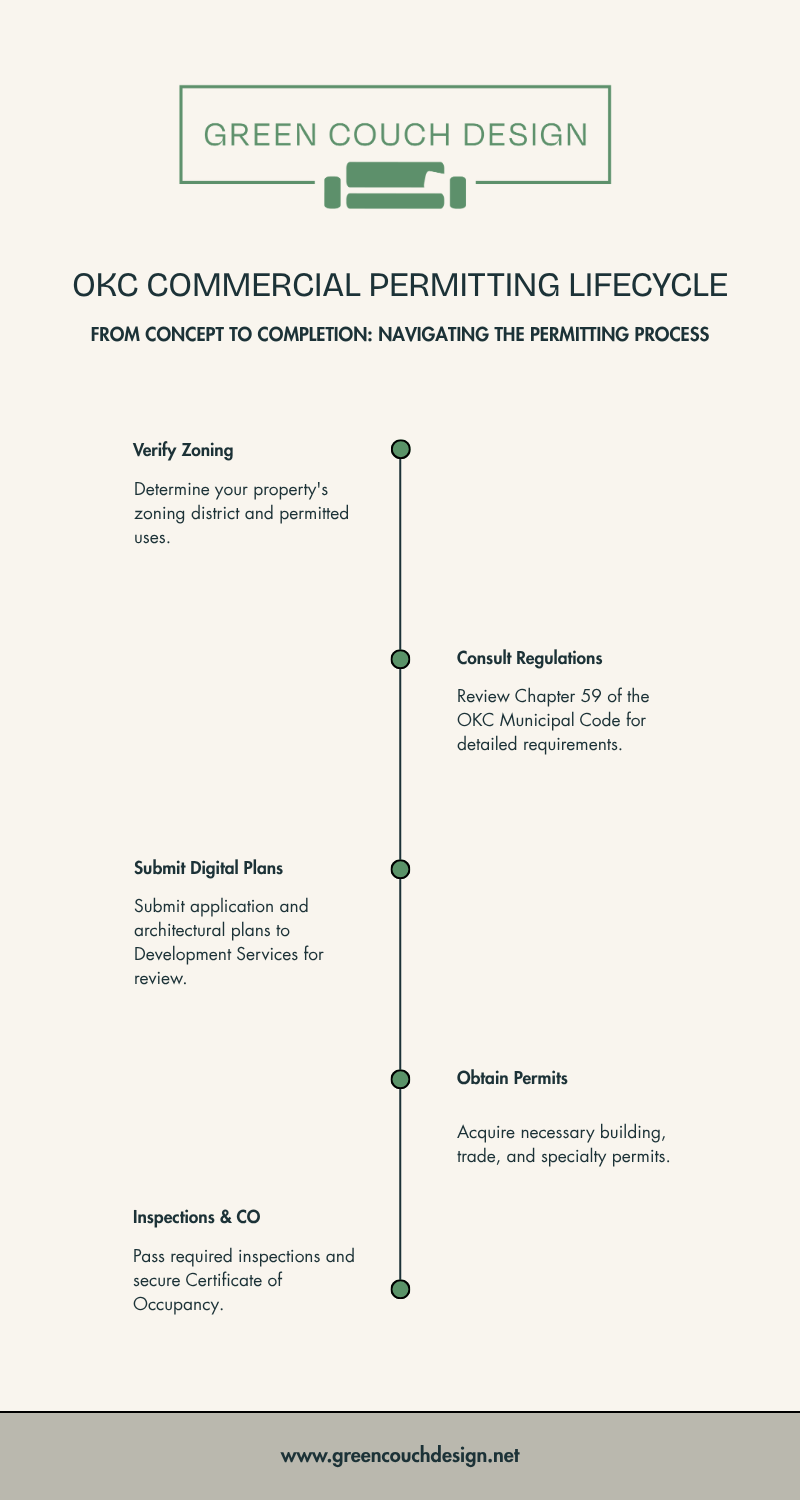
Quick Answer: Essential Steps for OKC Commercial Projects
- Determine your property's zoning district using the official Zoning Map or by contacting Subdivision and Zoning at (405) 297-2623
- Review Chapter 59 of the Oklahoma City Municipal Code for permitted uses, setbacks, parking, and landscaping requirements
- Submit digital plans to the Development Services Department for commercial plan review
- Obtain required permits through the Development Center (building, trade, and specialty permits)
- Schedule inspections at key construction milestones
- Secure a Certificate of Occupancy (3-4 business days for TCO review once inspections pass)
The difference between a smooth commercial development and a costly delay often comes down to understanding what the city requires before you break ground. Oklahoma City's zoning and permitting framework exists to protect community health, safety, and welfare while implementing the city's comprehensive plan.
The city enforces the International Building Code (2018), National Electrical Code (2017), and other ICC standards through its Development Services Department. All commercial projects require digital plan submissions, and most need multiple permits coordinated across building, electrical, plumbing, and mechanical systems.
The Regulatory Foundation: Zoning vs. Subdivision
To build something that lasts, we must first understand the ground it stands on—not just the soil, but the legal framework. In Oklahoma City, two primary sets of rules dictate land development: zoning and subdivision regulations. While they often overlap in a project's early stages, they serve different purposes.
Zoning is the set of rules that govern how land may be used. It establishes the "character" of a neighborhood by separating industrial zones from residential ones and commercial hubs from agricultural land. These standards are contained within Chapter 59 of the Oklahoma City Municipal Code, which acts as the playbook for all local development.
Subdivision, on the other hand, is the act of dividing land into smaller lots, tracts, or parcels. If you are taking a large piece of land and splitting it to create a new commercial park, you are dealing with subdivision regulations. This process often involves the dedication of new roads, highways, or public easements to the city.
Both systems are tools used to implement the City’s comprehensive plan, known as PlanOKC. The Planning Commission makes recommendations on zoning changes, but the City Council holds the final authority. For us as architects, these regulations aren't just problems; they are the parameters that ensure a project is intentional and compatible with its surroundings.
Determining Your Zoning District
Before we ever put pen to paper for a new OKC Commercial Architecture project, we must verify the "Straight Zoning" of the parcel. Oklahoma City provides an interactive Zoning Map that allows us to search by address, intersection, or case number.
Each zoning district has specific development standards, including:
- Permitted Uses: What business activities can actually happen here?
- Lot Sizes and Densities: How much of the lot can the building cover?
- Setbacks: How far must the building sit from the property line?
- Landscaping and Screening: What kind of "green" buffers are required between you and your neighbors?
- Parking: How many off-street spaces are required based on your building's square footage and use?
If your project doesn't fit the standard "Straight Zoning" categories, you might explore a Planned Unit Development (PUD) or a Simplified Planned Unit Development (SPUD). These are types of rezoning that allow for greater design flexibility and ingenuity, often used for mixed-use projects where traditional zoning categories are too restrictive.
The Role of Subdivision Regulations
If your commercial project involves more than just building on an existing, platted lot, you will encounter the City of Oklahoma City Subdivision Regulations. These control how land is divided and how infrastructure is dedicated.
Common actions include:
- Platting: Creating a formal map of the land division that is filed with the county.
- Lot Splits: Dividing a single lot into two.
- Deed Approval: Ensuring the legal description of the land matches city requirements.
- Easement Closures: If an old utility easement runs right through where your new foundation needs to be, you’ll need to apply for a closure.
Navigating these requirements early is vital. You cannot obtain a building permit on land that hasn't been properly platted or subdivided according to city standards.
Navigating OKC Commercial Zoning & Permitting: The Application Process
Once the zoning is confirmed, the real work of Navigating OKC Commercial Zoning & Permitting moves into the Development Services Department. Oklahoma City has modernized this process significantly, requiring digital plan submissions for almost all commercial projects.
We start by gathering the necessary documentation. A typical commercial application isn't just a set of floor plans; it's a comprehensive package that includes:
- Detailed Site Plans: Showing building placement, parking, drainage, and utilities.
- Architectural Blueprints: Stamped by a licensed architect (required for commercial work).
- Engineering Specifications: Structural, electrical, plumbing, and mechanical details.
- Energy Compliance Forms: Proving the building meets the International Energy Conservation Code (IECC).
For projects in specialized sectors, such as Industrial Architecture, the requirements may include additional environmental or safety reviews due to the nature of the equipment and materials involved.
Navigating OKC Commercial Zoning & Permitting Requirements
Beyond standard building codes, Oklahoma City has several "layers" of review that might apply to your project.
Design Review Areas: Specific parts of the city, like Downtown, Bricktown, or the Stockyards, require design approval to ensure new construction fits the historic or aesthetic character of the area. Zoning Overlays: These are special zoning areas (like the Airport Height Ordinance or Flood Hazard Districts) that impose additional regulations on top of the base zoning. Special Permits: If you want to operate a business that isn't typically allowed in your district—like a kennel in a retail zone—you may need a Special Use Permit. This involves a formal application process to demonstrate the use is compatible with the area.
Navigating OKC Commercial Zoning & Permitting Timelines
Time is a critical resource in development. The Development Center’s Plan Review staff operates from 8 a.m. to 5 p.m., Monday through Friday. While trade permits for simple repairs might be issued quickly, a full commercial plan review for a new Healthcare Architecture facility or complex remodel can take several weeks.
You can track your application status 24/7 through the OKC Development, Permitting and Licensing Portal. This portal is your central hub for:
- Submitting new applications.
- Paying permit fees.
- Responding to reviewer comments.
- Scheduling inspections.
We recommend building a "buffer" into your project timeline for the plan review phase. It is common for reviewers to have questions or require minor adjustments to the plans to ensure full code compliance.
Technical Standards and Contractor Licensing
Oklahoma City doesn't just make up its own rules; it adopts international standards to ensure buildings are resilient and safe. Currently, the city follows a suite of 2018 International Codes (IBC, IPC, IMC, IFC, IRC) and the 2017 National Electrical Code (NEC).
The Oklahoma Uniform Building Code Commission (OUBCC) adopts these codes at the state level, and the City of Oklahoma City enforces them locally with specific "OKC Supplements."
State and Local Licensing
One of the most common points of confusion in Navigating OKC Commercial Zoning & Permitting is the dual-layer of contractor licensing.
- State Level: The State of Oklahoma requires all electrical, plumbing, mechanical, roofing, and elevator contractors to be licensed through the Construction Industries Board (CIB).
- City Level: Even with a state license, these contractors must also register with the City of Oklahoma City to perform work within city limits.
Interestingly, the State of Oklahoma does not require a license for commercial general contractors. However, the City requires proof of liability insurance and workers' compensation insurance. As a business owner, you should always verify that your contractors are both state-licensed and city-registered before work begins. DIY work on commercial electrical, plumbing, or mechanical systems is strictly prohibited; these tasks must be performed by licensed professionals.
Project Types Requiring Permits
If you are doing more than just painting or laying new carpet, you likely need a permit. In OKC, permits are required when you:
- Construct a new primary or accessory structure.
- Alter or repair an existing building (including structural modifications).
- Enlarge a space (additions).
- Move or demolish a structure.
- Install or replace major systems (HVAC, water heaters, electrical panels).
- Erect signage (commercial signs require their own specific permits).
Even something as seemingly simple as a commercial fence or a storm shelter requires a permit to ensure it doesn't interfere with drainage or utility easements.
Finalizing the Project: Fees, Inspections, and Occupancy
As the project nears completion, the focus shifts to inspections and final approvals. Building permit fees in Oklahoma City are generally valuation-based, meaning the cost of the permit is tied to the total value of the construction project. Trade permits (electrical, plumbing, mechanical) often use a combination of flat rates and specific item charges.
In addition to permit fees, new commercial developments may be subject to "Impact Fees." These are one-time charges used to fund the expansion of city parks and streets necessitated by new growth. You can use the City’s online calculator to estimate these costs early in your budgeting process.
Obtaining a Certificate of Occupancy
The Certificate of Occupancy (CO) is the final "green light." It proves that the building has been inspected, meets all safety codes, and is ready for its intended use. You cannot legally open your doors to the public or move employees into a new space without a CO.
For Civic & Public Architecture, where buildings serve large numbers of people, the CO process is exceptionally rigorous, ensuring every fire suppression system and accessibility ramp is perfect.
| Feature | Certificate of Occupancy (CO) | Temporary Certificate of Occupancy (TCO) |
|---|---|---|
| Purpose | Final approval for permanent use | Allows limited use while finishing minor items |
| Duration | Permanent | Valid for a specific, short timeframe |
| Residential | Required | Not issued for residential property |
| Review Time | After final inspections | 3-4 business days |
| Fees | Included in permit | Requires separate application and fees |
Temporary Certificate of Occupancy (TCO) Requirements
Sometimes, a business needs to move in furniture or train staff before the entire construction project is 100% complete. In these cases, you can apply for a Temporary Certificate of Occupancy (TCO).
To get a TCO in Oklahoma City, you must:
- Submit a TCO Request Form stating the specific reason (e.g., "setting up displays").
- Provide a definite date for total project completion.
- Pass all "Temporary Final" inspections for life-safety systems (fire alarms, exits).
- Pay the TCO fee.
- Ensure all related permits (signs, driveways, etc.) have been issued and inspected.
A TCO review typically takes 3 to 4 business days. If you need to extend a TCO, you must submit a new application and pay additional fees. It’s important to note that TCOs are for commercial projects only; the city does not issue them for residential properties.
Frequently Asked Questions about OKC Permitting
Who should I contact for specific zoning or platting questions?
For questions regarding the zoning code, rezoning applications, platting, lot splits, or special permits, you should contact the Subdivision and Zoning staff at (405) 297-2623 or email them at SubdivisionandZoning@okc.gov. For general building permit questions, the Development Center can be reached at (405) 297-2525.
How are commercial building permit fees calculated?
Most commercial building permit fees in Oklahoma City are based on the total valuation of the project. The city also uses flat rates for specific trade permits and may assess impact fees for parks and streets based on the type and size of the development.
What documentation is required for a commercial permit application?
At a minimum, you will need a completed permit application, digital construction drawings (site plan, floor plans, elevations, and structural details) stamped by a licensed professional, and energy code compliance forms. Specialty projects like storm shelters require additional engineered specifications.
Conclusion
Navigating OKC Commercial Zoning & Permitting is a journey that requires patience, expertise, and a commitment to doing things right. At Green Couch Design, we believe that purposeful architecture is built on a foundation of regulatory clarity. By understanding these rules early, we can design spaces that aren't just beautiful, but are also functional, safe, and ready to serve the community for generations.
Whether you are planning a new medical clinic, an industrial warehouse, or a local retail shop, the process is the same: verify your zoning, prepare intentional plans, and work collaboratively with the City’s Development Services.
If you’re ready to start your next commercial project in Oklahoma City, we’re here to help you steer the complexities of the process. Contact Us today to discuss how we can bring your vision to life with a design that is built to last.